Gemini 4 Hydrogen, Neon, Carbon and Argon: which one fits which task
All four Gemini 4 models are in MultiChats as of 22 November 2026. What separates Hydrogen, Neon, Carbon and Argon, where each one earns its place, and how Google's own plans package them.
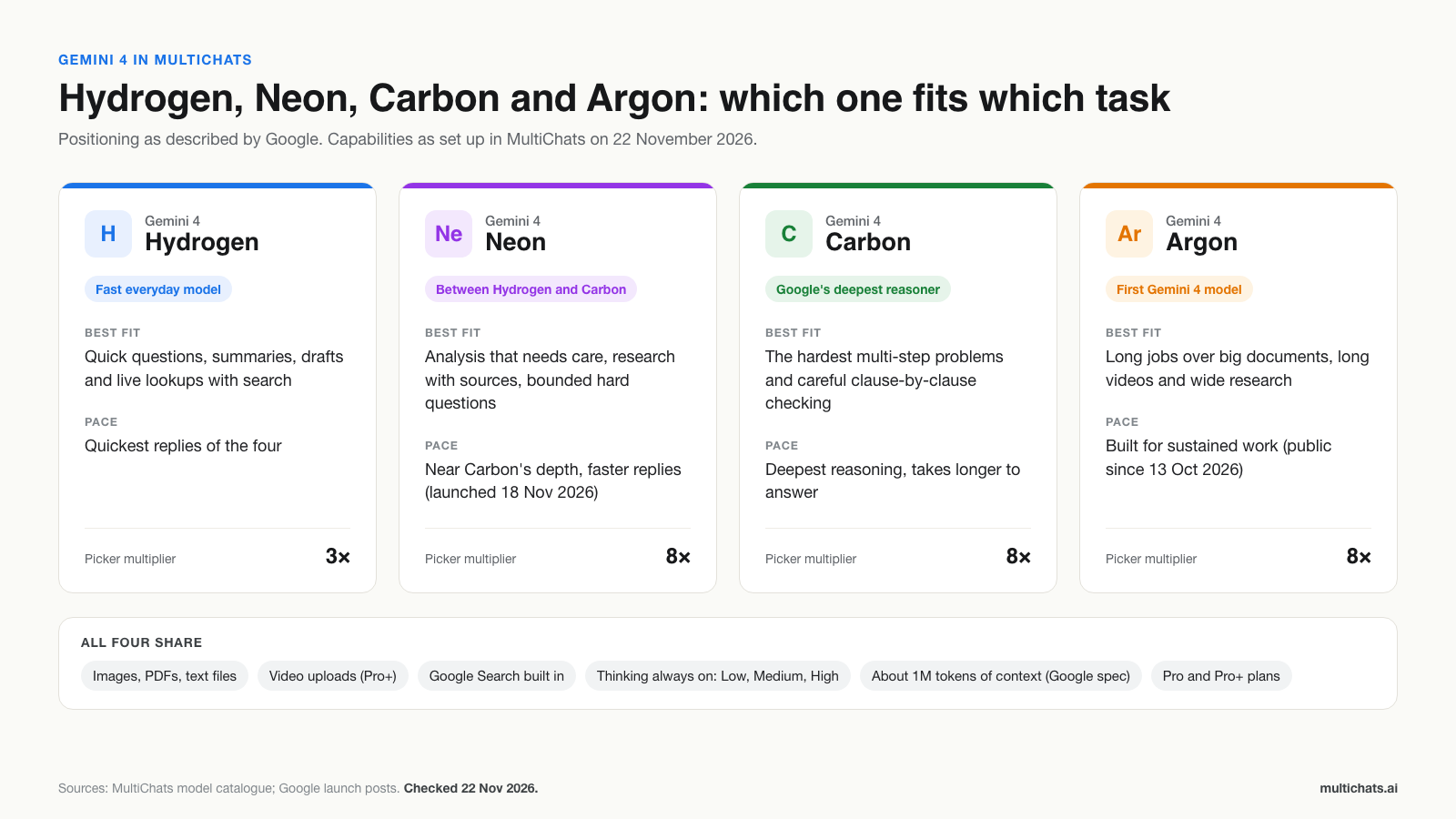
Use Gemini 4 Hydrogen for everyday questions where a quick reply matters more than a long think. Reach for Gemini 4 Neon when you need a careful answer without a long wait. Keep Gemini 4 Carbon for the hardest problems, when a more thorough answer is worth waiting for. Gemini 4 Argon, the oldest of the four, is built for long, multi-step work across large documents, long videos and extended research.
All four are live in MultiChats as of 22 November 2026, on the Pro and Pro+ plans, and you can move between them in the middle of a single conversation. Google offers the same family in its Gemini app, with access depending on your plan.
Four elements, and no obvious order
Google dropped the familiar Pro and Flash labels for this generation and named its models after chemical elements instead. The names stick, though they give little away. Nothing about hydrogen, neon, carbon or argon tells you which model is quick, which is careful or which came first. If you tried to read the line-up off the periodic table, you would rank Neon above Carbon, since neon has the higher atomic number. Google places Neon below Carbon. Argon, the heaviest element of the four, was the first to arrive.
The release order explains some of the confusion. Google announced Argon on 30 September 2026, gave it first to vetted security teams, and opened it to Google AI Pro and Ultra subscribers on 13 October. Hydrogen, Neon and Carbon followed in November, with Neon arriving on 18 November. For about five weeks, "Gemini 4" in practice meant Argon.
Google's own app has since started grouping the models by what each is meant to do. Think of Hydrogen as everyday help, Neon as the next step for analysis and Carbon as the option for the most complex work. We have written before about why AI model names have become so hard to read, and the Gemini 4 family shows why.
MultiChats puts the leading AI models in one app. Try it free
What the four share in MultiChats
Every Gemini 4 model in MultiChats reads the images, PDFs and text files you attach, and all four accept video uploads, which in MultiChats come with the Pro+ plan. All four have Google Search built in, so they can look up current prices, opening hours, news or results and point you to what they found, provided web search is switched on for that message. Google rates each model at roughly one million tokens of context on its own platform. That's enough room for a long book or a thick stack of reports. MultiChats has its own context limits.
All four also think before they answer, and that thinking cannot be switched off. You choose Low, Medium or High effort, and Low is the floor. There are two things none of them does in MultiChats: they do not run voice calls, which use other models in the app, and they do not draw pictures themselves. Image generation in MultiChats is a separate tool that makes one image per message.
The models differ in how far they go before giving you an answer. A faster model reaches a good answer in fewer steps and hands it back sooner. A deeper model explores more possible routes, has more room to catch mistakes along the way and takes longer to reply. Every model in the MultiChats picker also shows a credit multiplier, the number of message credits one reply uses. For this family it reads 3× on Hydrogen and 8× on the other three.
Model | How Google positions it | Where it fits best | Picker multiplier |
|---|---|---|---|
Gemini 4 Hydrogen | Fast everyday model | Quick questions, summaries, drafts, live lookups | 3× |
Gemini 4 Neon | Between Hydrogen and Carbon, launched 18 November 2026 | Analysis that needs care, research with sources | 8× |
Gemini 4 Carbon | Google's deepest reasoning model | The hardest multi-step problems, careful checking | 8× |
Gemini 4 Argon | First Gemini 4 model, public since 13 October 2026 | Long jobs over big documents, video and research | 8× |
Hydrogen: the one to leave open
Start with Hydrogen for most conversations. You'll notice the shorter wait once you get past the first reply. You paste in a confusing letter from your energy supplier and ask what it means, then ask what you should say back, then ask for a shorter version. You attach a thirty-page PDF from your child's school and want the three dates that matter, then a reminder list, then a polite email to the teacher. Often, those follow-ups are where you get the answer you can actually use. Short waits help you keep your train of thought.
Hydrogen still thinks before it answers. It belongs to the same generation as the others and reasons on every reply; it simply does less of it per question. With effort on Low, replies come back fast. Move it to High and it will take more time over a knotty question, which is often all a question needs. Because it can search the web, it is also a good first choice for questions that need current information. You can ask whether a train strike affects your Thursday, what a product currently sells for, or what changed in a rule you half remember.
You will notice the limits when the question has a lot of moving parts. Questions with many interacting conditions, such as a tax situation that spans two countries, give it more to hold than it is designed for. So do long chains of reasoning where an early slip quietly carries through to the end, and anything you would normally ask a specialist to double-check. Those are the moments to switch.
When to move from Neon to Carbon
Neon is the newest of the four, released on 18 November 2026, and Google pitches it as a model that gets close to Carbon's depth while answering noticeably faster. Carbon is Google's heavy reasoner, aimed at long problems with many steps and the kind of work where the model needs to check its own reasoning before committing to an answer. In MultiChats the two share every capability listed above and the same 8× multiplier, so the choice comes down to patience and how much depth the question demands.
Say you are comparing three mortgage offers with different fixed periods, arrangement fees and overpayment rules, and you want to know which comes out ahead over five years if rates rise. There is a fair amount of arithmetic, and you already have the figures and the assumptions you want the model to use. Neon is a good fit. Now say you have a lease with a break clause, a rent review clause and a repair clause that seem to contradict each other, and you need to know what happens if you leave after eighteen months. Every clause changes the meaning of the others, and a confident wrong answer could cost you real money. Carbon can help you work through those links before you get the interpretation checked.
Independent tests of Neon only started appearing after 18 November, and we have not yet run enough ordinary conversations through both models to rank them confidently on everyday questions. A sensible habit in the meantime is to ask Neon first. If the answer feels thin, or you spot an error, switch to Carbon in the same thread and ask it to check Neon's reasoning step by step. Our guide to when a thinking model is worth the wait goes further into how to judge it.
Argon, the early arrival
Google launched Argon with a narrow audience and a broad brief. Its first users were vetted cyber security teams, but Google's examples of what it can do range from legal and financial research to spotting small details in long videos. Google also says that on its own platform Argon can write up to a million tokens in a single response.
In MultiChats, give Argon a job that needs sustained attention. For instance, ask it to reconcile reports in a shared folder or trace how a speaker's argument develops over a recorded lecture. It can also gather sources with search and weigh their findings in the same thread. Since Neon and Carbon arrived, Argon is less obviously the default for a single hard question, and Google has not published a direct comparison between Argon and Carbon that we could find as of 22 November 2026. Treat any confident ranking of the two with caution. Where Argon still earns its place is sustained work over very large inputs, and our look at which AI handles the longest documents covers that kind of work in more depth.
How Google sells the same family
Google's Gemini subscriptions page lists the US monthly prices below, checked on 22 November 2026. It confirms Hydrogen on Plus, Neon and Hydrogen on Pro, and Carbon on Ultra. Argon access in the table is as reported at launch. Check Google's current plan details before you subscribe.
Google plan | US price per month | Gemini 4 access, as reported | How usage is limited |
|---|---|---|---|
Free | $0 | Lighter models by default | Standard limits |
Google AI Plus | $4.99 | Hydrogen | 2× the standard limits |
Google AI Pro | $19.99 | Hydrogen, Neon and Argon | 4× the standard limits |
Google AI Ultra | $99.99 or $199.99 | All four, including Carbon | 5× or 20× the AI Pro limits |
Google stopped counting messages in May 2026. Its limits are compute-based, refresh every five hours up to a weekly ceiling, and are published as multiples of a baseline it does not quantify. Our explainer on what Gemini's 2x, 4x and 20x actually get you walks through how that works in practice.
Google's plans also bundle things a chat app does not offer: generous cloud storage, Gemini inside Gmail and Docs, video generation and Deep Research. If those matter to you, AI Pro gives you those extras alongside Hydrogen and Neon, with Argon access reported at launch. The gap is Carbon, which Google reserves for Ultra at $99.99 a month and up. In MultiChats all four Gemini 4 models are on Pro, at $20.99 a month or $199.99 a year with 1,500 message credits a month, and on Pro+, at $34.99 a month with 3,000 message credits a month. Across its catalogue, MultiChats carries 63 models from 16 providers, including Claude and GPT. The current plans are on the MultiChats homepage.
Switching mid-chat, and when it is worth the bother
You can change models as a question develops. Start in Hydrogen with a rental agreement, for example, and ask for a plain summary. When the summary turns up a clause that worries you, you switch to Carbon in the same thread and ask what that clause means in your situation. The whole conversation, the attachment included, carries across. If you then want to try a different line of questioning without losing the first, you can branch the chat, which opens the alternative in a new thread and leaves the original as it was.
Switch when the first answer gives you a different job to do. A quick lookup might tell you when a policy takes effect. Working out which parts apply to your situation may call for a more careful read.
If you only get to know one of the four, make it Hydrogen, and reach for the others once a question has shown it needs them. Neon is the sensible step up for analysis that needs care. Carbon is for problems you would otherwise take to a specialist. Argon is for the long haul over big inputs. Once you've tried each on a real task, the names become easier to place.