GPT-6.2 Sol and GPT-6.2 Astra: what changed and where to use them
OpenAI released GPT-6.2 Sol and GPT-6.2 Astra on 17 November 2026. What is new, where each one fits, and the one thing to know before you use them in MultiChats.
One day. OpenAI announced GPT-6.2 Sol and GPT-6.2 Astra on 17 November 2026, and both have been in the MultiChats model picker since 18 November.
Sol is the everyday model. Astra takes on harder questions. Both think before they answer, both read your files, and neither can search the web inside MultiChats.
If the answer depends on current information, start with a model that can search.
What OpenAI changed
GPT-6.2 updates the GPT-6.1 models that arrived in late September and October. Here's what changed, according to OpenAI and early independent tests.
Better results on long, multi-step professional tasks, the kind that involve reading, planning and writing in stages.
OpenAI says both models use fewer output tokens, the small chunks of text that make up a reply.
Quicker responses from Sol than from GPT-6.1 Sol, according to early independent tests.
A context window of about 1.05 million tokens on both models in OpenAI's specs. MultiChats has its own context limits.
OpenAI offers both models in ChatGPT's Work section and in Codex on its paid plans. Whether they reach ChatGPT's ordinary chat on your plan depends on OpenAI's rollout, so check the model menu in your own account.
MultiChats puts the leading AI models in one app. Try it free
GPT-6.2 Sol, in plain terms
Start with Sol when you need a considered answer and expect a bit of back-and-forth.
Good fits:
Turning rough notes into a clear report or cover letter.
Reading a long PDF and pulling out the parts that matter to you.
Planning something with moving parts, like a two-week trip with fixed dates.
Explaining a hard topic step by step, then quizzing you on it.
For most people, Sol is the better default of the two.
Thinking is always on. You pick Low, Medium or High effort, and Low is the floor. There is no Off setting. In the MultiChats picker, Sol shows a 4× credit multiplier.
GPT-6.2 Astra, in plain terms
Astra is OpenAI's flagship. Give it a problem where you want to see the reasoning worked out in full.
Good fits:
Checking a contract, a lease or an insurance policy clause by clause.
Working through a hard maths or science problem with every step shown.
Long research write-ups where the argument has to hold together from start to finish.
Big decisions with many trade-offs, like weighing two job offers with different pay, pensions and commutes.
It is also the model to try when Sol's answer feels thin.
Astra takes longer to reply. Some early testers also saw it go round in circles on very long, open-ended jobs, so give it a specific question and say what a finished answer should cover. Thinking is always on here too. Astra shows an 8× multiplier.
Sol or Astra? A quick way to decide
Ask yourself one question: what happens if the answer is slightly wrong?
If you would spot it and fix it, use Sol.
If an error could change your decision, ask Astra to show its reasoning and check the parts you plan to rely on.
If the answer depends on current facts, start with a model that searches.
Most everyday tasks land in the first group. Astra is for the smaller set of questions where depth is worth the wait.
You can also use both in one thread. Draft with Sol, then switch to Astra and ask it to check the draft for mistakes.
What stays the same
Both read the images, PDFs and text files you attach.
Neither runs voice calls in MultiChats.
Neither draws pictures itself. Image generation is a separate tool that makes one image per message.
Both are on the Pro and Pro+ plans. Free accounts cannot pick them.
The catch: no web search here
Web search is off for GPT-6.2 Sol and GPT-6.2 Astra in MultiChats. The same goes for GPT-6.1 Sol.
So neither model can check a live price, a news story or an opening time for you. Ask about a recent event and you may get a confident answer built on older information.
You can switch to a search-capable model in the same chat.
Gemini 4. Hydrogen, Neon, Carbon and Argon all have Google Search built in.
Claude. Claude Opus 5.5, Sonnet 5.5 and Haiku 5.5 can all search the web.
Your conversation stays in the same thread, attachments included. A pattern that works well: gather the current facts with Gemini 4 or Claude, then switch back to Sol or Astra to reason over them or write them up.
Say you are planning a weekend in Lisbon. Ask Gemini 4 Hydrogen, with search on, for opening hours and events on your dates. Then switch to GPT-6.2 Sol and ask it to turn that list into a sensible itinerary. Ask it to put stops near each other on the same day.
Where each OpenAI model fits
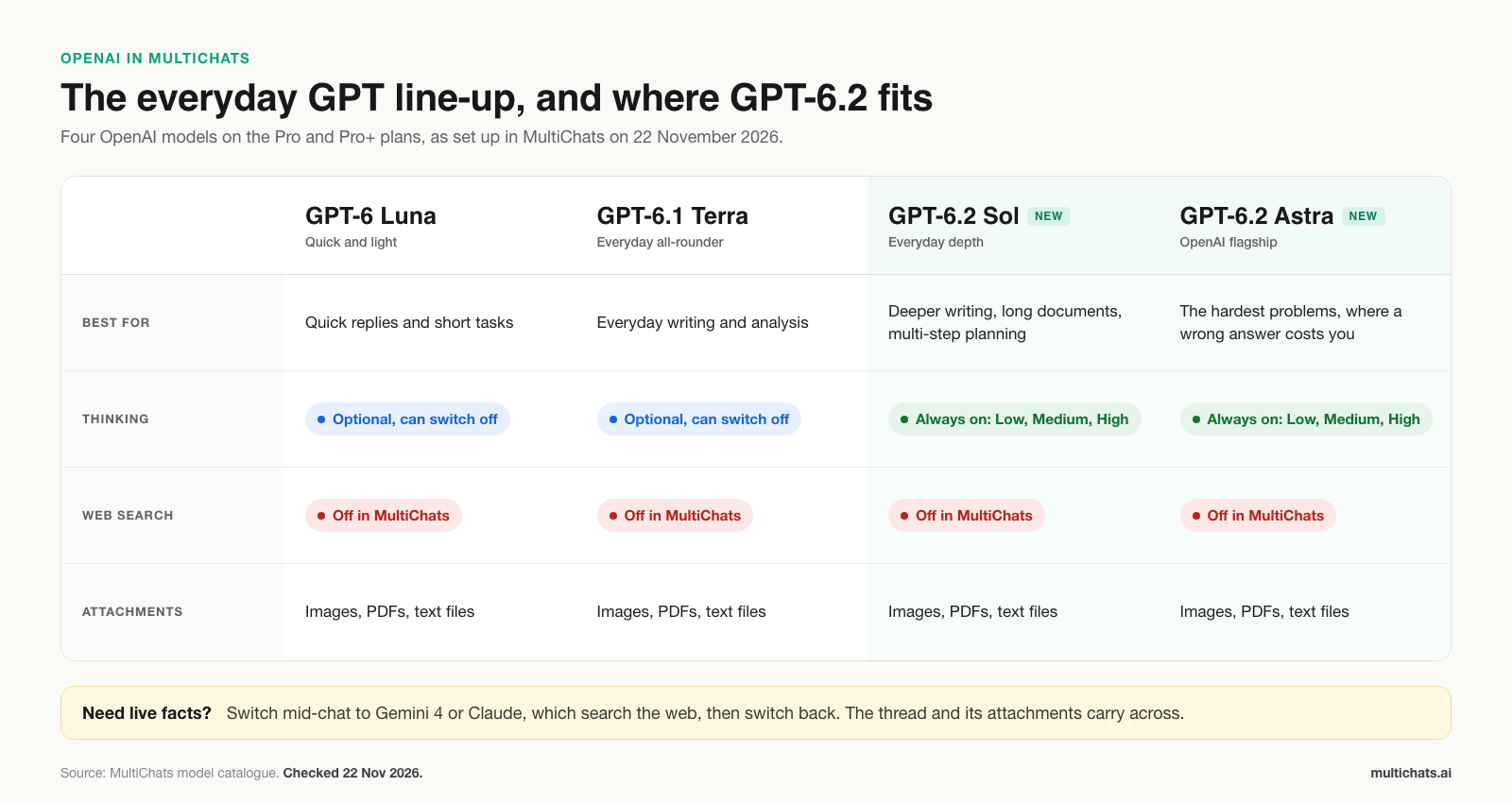
OpenAI's current everyday line-up in MultiChats has four models, all on the paid plans as of 22 November 2026:
GPT-6 Luna. Quick replies and short tasks. Thinking can be switched off.
GPT-6.1 Terra. Everyday writing and analysis, with thinking you can turn on or off.
GPT-6.2 Sol. Deeper writing, document reading and multi-step planning. Thinking always on.
GPT-6.2 Astra. The hardest problems. Thinking always on.
All four read images, PDFs and text files. None of the four has web search in MultiChats. Try Sol for a first pass. For something short, like tidying a note, Luna is usually enough.
What about GPT-6.1 Sol?
It is still in the picker, with the same 4× multiplier as GPT-6.2 Sol.
You can keep a long thread on 6.1 Sol. For a new conversation, start with 6.2 Sol if you want the latest version. Our earlier piece covers where GPT-6.1 Sol was available when it launched.
Quick checks before you start
Need live facts? Start in Gemini 4 or Claude, then switch to Sol or Astra.
Long document? Attach it and ask specific questions. More on that in which AI handles the longest documents.
Not sure how much thinking a question needs? Start on Low and raise it if the answer feels thin. Our explainer on reasoning models covers the basics.
Plans. Pro is $20.99 a month with 1,500 message credits. Pro+ is $34.99 a month with 3,000 message credits. Details are on the MultiChats homepage.
The version number moved by 0.1. For most people, the missing web search will matter more than that.